

The Future of Insurance in India is being shaped by more than just capital and competition. Customer trust, claims servicing and distribution strength may decide future winners. India’s insurance market is booming. New money is pouring in. New insurance licenses are expanding market participation.. Technology is transforming how people buy and claim insurance. Global investors are watching closely. Yet here’s the uncomfortable truth: capital alone won’t determine who wins in this market.
Customer trust will.
Why This Moment Matters
India’s insurance industry is at an inflection point. The numbers tell the story—insurance awareness is growing, regulatory reforms are opening doors, and technology adoption is accelerating. But dig deeper, and you’ll find that insurance penetration in India still lags behind developed markets. That gap? It’s actually an enormous opportunity for companies willing to think long-term instead of chasing quick wins.
The problem is, most new entrants are focused on the wrong metrics.
You can also explore our detailed analysis on India’s insurance market here:
India’s Insurance Market Analysis
The Trust Paradox in Insurance
Here’s something insurance companies often overlook: customers don’t judge you when they’re buying a policy. They judge you when they need you most—during a claim.
Think about it. When you’re shopping for insurance, you compare premiums. You look at features. But when disaster strikes and you file a claim, suddenly everything changes. Now you care about:
- How quickly the company responds
- How transparent they are about the process
- How smooth the entire experience feels
- Whether they actually pay when they should
Poor communication kills trust. Delays create frustration. But smooth claims handling? That builds loyalty that no discount can match.
As competition heats up, insurance companies will stop competing purely on price. Instead, they’ll compete on service quality, transparency, and how well they handle the moments that matter most.
The Real Game Changer: Rural and Smaller Markets
Here’s another blindspot many insurers have: they’re obsessed with tier-1 cities.
For years, the insurance industry treated metro cities as the only game in town. But the real opportunity? It’s in smaller cities and rural India.
Millions of people in these areas are underinsured. Financial literacy is improving. Digital access is expanding. Yet insurance companies are still chasing the same saturated metro markets everyone else is targeting.
The next wave of growth won’t come from Mumbai or Delhi. It’ll come from the towns and villages where insurance needs are high but coverage remains low. Future insurers that focus only on Tier 1 markets may risk missing India’s largest untapped insurance opportunity.
What the Numbers Actually Show
Let’s look at what’s really happening in the market.
Newer insurance companies are growing. Year after year, their market share inches upward. You can see the innovation. You can see the hustle. But here’s the reality: established insurers still control most of the market.
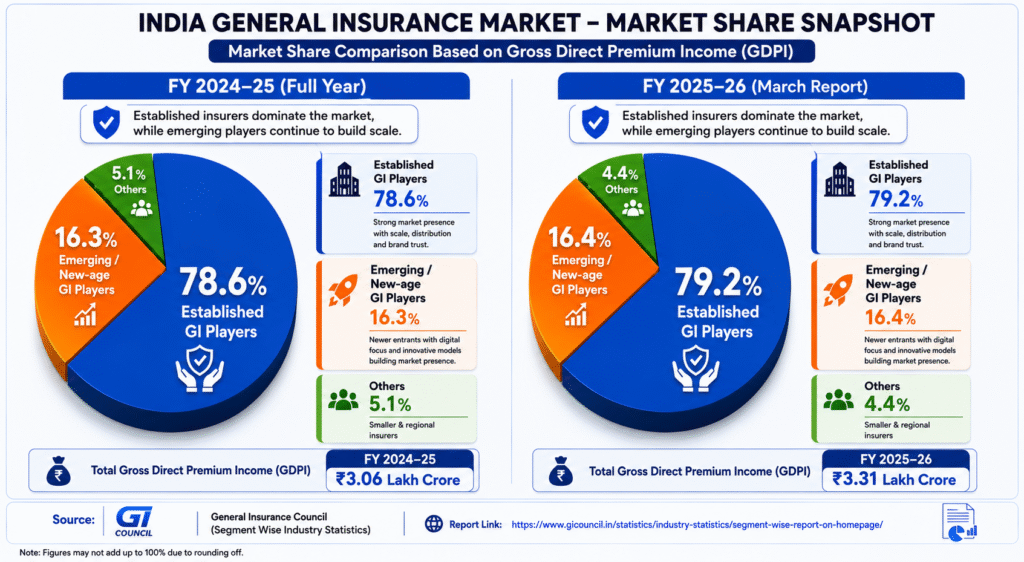
This tells us something important: entering India’s insurance market is hard. Building real scale is even harder.
The question this raises isn’t trivial: Can money alone buy market leadership? Or does trust actually matter more? The answer is probably both. But if you had to bet on one factor, trust would be the safer bet.
Claims Experience: The Silent Competitive Advantage
Let’s be direct: claims servicing is where insurers win or lose.
Claims servicing is not only an operational process. It is a reputation engine. Customers may forget premium differences over time. They rarely forget a difficult claim experience. Customers expect faster responses now. They want transparency about what’s happening with their claim. They want simple, straightforward processes. They don’t want to chase companies for updates.
Technology will help. AI-powered claim processing, mobile-first experiences, and digital claim journeys will all improve efficiency. But here’s the catch—technology alone won’t create loyalty. It’s what you do with that technology that matters.
The insurance companies that respond quickly, communicate clearly, and resolve claims smoothly will build something money can’t easily replicate: customer loyalty.
As more players enter the market, this advantage will become even more valuable.
The Real Path to Market Leadership
So what actually determines who wins?
It’s not just one thing. Capital matters. Technology matters. Distribution matters.
But the companies that will actually own this market are the ones that master:
- Customer trust—through transparent, honest dealings
- Claims excellence—because that’s when customers remember you
- Distribution reach—especially in overlooked smaller cities and rural areas
- Long-term thinking—resisting the pressure to chase only quick growth
The Bottom Line
Here’s the hard truth that separates winners from everyone else:
Capital gets you in the game. Trust keeps you in the game.
New capital will continue entering India’s insurance industry. Technology will continue improving efficiency. Competition will continue intensifying. But market leadership may increasingly belong to insurers that build trust before scale and service before expansion.
You can use money to launch products, build offices, and run aggressive marketing campaigns. But you can’t buy customer trust. You have to earn it. Every single day.
The insurance companies that recognize this shift early—moving from a capital-and-pricing focus to a trust-and-service focus—will be the ones still standing when the dust settles.
India’s insurance market is far from decided. But the companies building for the long term, serving customers honestly, and expanding into overlooked markets? They may ultimately become the companies that shape India’s next insurance growth cycle.
External Source:
General Insurance Council Industry Statistics:
General Insurance Council Statistics
IRDAI Official Website:
IRDAI Official Website
Great content! Keep up the good work!